Showing posts with label creation museum. Show all posts

Friday, November 13, 2009

tUPoC - Chapter 1 Section 4

This is a book by Dr. Jason Lisle of Answers In Genesis (AiG). Here is a short background on him posted on Amazon's page for this book.

"Dr Jason Lisle is a research scientist and speaker with Answers in Genesis Ministries. He holds a bachelor's degree in physics and astronomy from Ohio Wesleyan University and a master's degree and PhD in astrophysics from the University of Colorado in Boulder. Dr Lisle is currently planetarium director at the Creation Museum near Cincinnati, and written a number of books and journal articles, as well as the programs currently being used in the planetarium."

I was able to see his talk on this same subject while visiting the Creation Museum in Kentucky run by AiG. I know PZ has covered the first chapter but I wanted to take a shot at, especially after hearing Lisle's speech. Chapter 1 of his book is available online here. I will be using part of this book in accordance with the Fair Use Copyright Laws within the United States of America.

Evidence and Rescuing Devices

"The scientific evidence certainly confirms biblical creation and appears to defy evolution. Many other evidences too numerous to list could also have been used as examples. It may seem that evolution stands refuted. It may seem that we have proved beyond doubt that scientific evidence proves biblical creation and disproves the notion of evolution. But this is not the case."

What evidence? The stuff you made up before that was easily refuted? If there is so much then show it, don't off handedly mention it and say take my word. From what I have read so far, Lisle's word is far from trustworthy.

"The above illustrations are very good arguments indeed. But they are not an ultimate proof. They do not actually prove biblical creation, nor do they utterly refute evolution or billions of years. The reason is that an evolutionist can always invoke what we might call a “rescuing device.” That is, an evolutionist can invent a story to explain away apparently contrary evidence. Let’s see how this works with the comets’ argument for a young solar system."

Notice the terminology here. An evolutionist can "invent" a story to explain away apparently contrary evidence. Sorry Lisle this is utter bullshit as we will see in your upcoming example. Scientists start with the evidence and determine what the evidence says from there. They do not start with their conclusion and just ignore contrary evidence, that is what creationists do. Lisle is just projecting here. If what Lisle said was right, there would be no evolution. We would all be talking about creation, because science started with creation and young earth that had the sun orbiting around it. The facts changed things. The idea of an old earth, which was backed up by more and more data, which moved the age of the earth further back until we reached the current age of the planet. This was not the work of an "evolutionist" as Lisle is claiming, instead it was the work of people like Lord Kelvin, a creationist, who spoke out against T.H. Huxley. So already this idea of coming from a predetermined position is on shaky ground.

"The evolutionist astronomer believes that the solar system is billions of years old, yet he sees comets within it. He can observe that comets disintegrate quite rapidly, and he computes that they can only last 100,000 years or so. How is he to resolve this dilemma? “Obviously,” says the secular astronomer, “there must be a source that generates new comets to replace the old ones as they disintegrate.” So secular astronomers have proposed that there is an “Oort cloud” (named after its inventor, Jan Oort). The Oort cloud is an enormous hypothetical sphere of icy masses surrounding our solar system. It is supposedly far beyond the most distant planets, beyond the range of our most powerful telescopes. Secular astronomers propose that occasionally, objects in the Oort cloud are dislodged from their distant orbit and thrown into the inner solar system to become brand new comets. Since these new comets continually replace the old ones, the solar system could be billions of years old after all."

Now we see what Lisle means by rescuing device. In science we call these predictions. In other words scientists realize that comets only last a 10,000 years or so, but the fact is that the universe is around 14 billion years old, based on convergance evidence from testing of separate sites and methods. Then there is a prediction, based on these two seemingly contradictory facts, that there is a place where comets are continually formed, the Oort cloud. Now here is where you are going to find a big difference between creation "science"'s "rescuing device" and science's predictions. Scientist are actively trying to identify the Oort cloud. They have determined some objects they believe to be inside it, but they are still actively seeking it. If they don't find any evidence of an Oort cloud then they will scrap it and look for another explanation for comets. This is a strength of science, being able to change when new evidence comes forth.

"Now keep in mind that no one has ever seen an Oort cloud. By construction, it is supposedly much too far away to detect the small objects within it. Currently, there is no observational evidence of any kind for an Oort cloud. So, as a creationist, I have no particular reason to think that there is such a thing. As far as I’m concerned, the Oort cloud exists only in the mind of evolutionists. It’s just a rescuing device that “saves” the evolutionist’s view from evidence that would otherwise seem to refute it."

Actually, objects have been observed in the area of where the Oort cloud should be. Oort cloud objects (OCOs) are showing up more and more as our telescopes increase in strength.

Argument from personal incredulity is still a logical fallacy. Just because you don't believe it doesn't mean it is not possible. Later, Lisle will show that no amount of evidence will change his mind, as he knows he is already right. So I ask which seems more sensible, taking what you know and developing ideas based off that and changing those ideas when new evidence arises or starting with your conclusion and cherry picking evidence that fits your conclusion to the point of ignoring and ridiculing any new evidence that doesn't support your conclusion? The first is what science does. The later is what AiG and every creation/intelligent design (ID)institution does. AiG is just more forward with stating that is what they do.

"Likewise, the evolutionist could also explain away the other arguments above by appealing to a rescuing device. Perhaps there is some kind of unknown mechanism that has contaminated the diamonds and other samples, creating new C-14 in them — in which case such things can be very old after all."

Or it could be like I posted, instrument contamination.

"Perhaps there is some as-yet-undiscovered mechanism that produces new information in DNA."

No need, duplication and mutation takes care of it just fine, like I showed previously.

"Perhaps nothing is truly irreducibly complex; it just seems that way due to our inability to imagine the stepwise process."

Actually you haven't shown anything to be irreducibly complex. No one has. Everything considered so far has shown to be not near as irreducible as creationists and IDers claim.

"The reason that mere evidences do not persuade people is that people can always invoke the unknown. This is why the above arguments do not really prove creation. Any evidence can be explained away by invoking a rescuing device."

True and creationists have the ultimate rescuing device, "God did it". How was every animal created? God did it. How did every animal on the planet reach the middle east to board Noah's ark? God did it. How did "information" get put into DNA? God did it. How do you verify this? Uhmmmm, prayer?

How do you verify there is an Oort cloud? Well through calculations, models, observations and building better telescopes that can identify smaller objects than what was possible before.

Notice the answer to the Oort cloud question is not an ending. Instead, we are still studying and trying to verify and learn more. Once a creationist says God did it, what is left to study? You have stopped, it is ended it is over nothing more to see here. That is the major difference between what Lisle calls "rescuing devices".

Now Lisle will try to justify rescuing devices because he knows he has the biggest end all rescuing device of all.

"Is a rescuing device unacceptable? Should we criticize the evolutionary astronomers for inventing a mere conjecture to rescue their opinion of vast ages rather than simply accepting the evidence at face value? My response may surprise you. The answer is: no — a rescuing device is not necessarily wrong. The fact is, we all have rescuing devices. We all have a way of thinking about the world — a worldview. Our worldview contains our most strongly held convictions about how the world works: how it came to be, the nature of reality, the nature of truth, and how we should live. No matter what worldview we have, there will always be some evidence that does not seem to fit it — at least on the surface. And therefore, everyone (whether creationist or evolutionist) must occasionally invoke a rescuing device in order to maintain rationality in his or her worldview."

Now we are starting to get to the heart of his real argument, worldviews or presuppositions.

"So I would not necessarily criticize the secular astronomers for inventing an Oort cloud (even though I don’t believe in one). After all, I don’t know for certain that there is not an Oort cloud either. The fact that we have no evidence for an Oort cloud does not prove that it does not exist. Absence of evidence is not the same as evidence of absence, so we cannot instantly dismiss evolutionary conjectures as necessarily impossible or irrational."

I am not criticizing them for putting forth the hypothesis of an Oort cloud, I just said I think it is a figment of evolutionists imagination. That is not derogatory at all, except when atheists say the same about God. Hypocrisy is so easy to find among Christian fundamentalists.

He is right absence of evidence is not evidence of absence. Instead we can lower the probability of something being true or real. Like for say a deity. The fact we have found no evidence of any deity does not mean one does not exist. The fact still remains that people claim to talk to a deity or deities and know what the deity/deities want. These people can't even agree when they are talking about the same deity much less other opposing deities. In fact they often contradict each other on the nature of the same deity. So they cannot all be right. They can all be wrong. In fact it is better percentage-wise to assume they are all wrong, especially without any corroborating evidence to any of their claims.

"Nonetheless, a conjecture must not be arbitrary. If I simply asserted that “the core of Jupiter is made of green cheese” simply because no one has proven otherwise, this would be an unacceptable position. In logical reasoning, no one is allowed to be arbitrary — to just assume something without a good reason. After all, if we’re just going to assume something with no reason, then we could equally well assume the exact opposite. Rational debate would be impossible if people simply assumed whatever they wanted and felt no need to provide a reason for their position. Therefore, people must have a reason for their rescuing device if it is to be considered rational."

Of course if the core belief is not rational, then I can reject any rescuing device your present no matter if it is reasonable through your core belief. This would be a false premise.

"As an example, consider the “distant starlight problem.” This is the argument that the universe must be billions of years old since it apparently takes a very long time for light from the most distant galaxies to reach earth. How would a creationist respond to this claim? As of the writing of this book, there is not a definitive, verified solution to distant starlight. Therefore, creationists must invoke a rescuing device to explain distant starlight. Several good models have been proposed that can potentially solve this difficulty. But since none of them have been conclusively proved, they remain conjectures — rescuing devices — at this point in time."

Has anything ever been conclusively proven by creationists? I am asking seriously.

What kind of studies are being done by creationists on distant star light? I would like to see this.

"Is this arbitrary? No, the creationist has a reason to believe that there is an answer to distant starlight. As a creationist, I am convinced that the Bible really is what it claims to be: the Word of God. As such, the Bible accurately describes the creation of the universe. My Christian worldview requires that God really did create in six days, just as He said He did. Therefore, I have a good reason to think that there really is a rational solution to distant starlight (possibly one of the existing models, or perhaps one that is as yet undiscovered). My reason for my rescuing device is that my worldview insists on one, and I have good reasons to know that my worldview is true."

Remember that false premise thing I mentioned earlier. I reject your premise that the Bible is entirely accurate. In fact I know of several Christians that do the same. So not only is this a false premise but a false dichotomy too. The Christian worldview does not require what you say, no it is a fundamentalist "literal" reading of the bible worldview that claims this. Of course if you point this out to them then they will fall back on the no true Scotsman fallacy, claiming that those people are not real Christians.

"So a rational person will appeal to his worldview as the reason for his rescuing devices. But then, of course, he must have good reasons for his worldview. Evolutionists (and other believers in vast ages) are perfectly justified in believing in an Oort cloud if, and only if, they appeal to their worldview. But appealing to one’s worldview is only rational if one’s worldview is rational. The debate over origins therefore must ultimately boil down to a debate over competing worldviews. As such, we must give some thought to the nature of worldviews and how to judge competing ones."

So now he finally gets to false premise. The next section is on worldviews and this is the bulk of his argument. Honestly I don't know of any scientist that claims there is an Oort cloud because of their "worldview". Instead it is because of facts and evidence, but we will get to all that when I cover the next and final section of Chapter 1.

I am not buying the book to cover more chapters, I will see if they have it in the local library though. Plus my mom gave me a Charles Colson book to read, claiming I owe her since she read the two Ken Miller books I gave her. So I may cover that instead.


Friday, November 6, 2009

The Ultimate Proof of Creation - Chapter 1 - Section 2

This is a book by Dr. Jason Lisle of Answers In Genesis (AiG). Here is a short background on him posted on Amazon's page for this book.

"Dr Jason Lisle is a research scientist and speaker with Answers in Genesis Ministries. He holds a bachelor's degree in physics and astronomy from Ohio Wesleyan University and a master's degree and PhD in astrophysics from the University of Colorado in Boulder. Dr Lisle is currently planetarium director at the Creation Museum near Cincinnati, and written a number of books and journal articles, as well as the programs currently being used in the planetarium."

I was able to see his talk on this same subject while visiting the Creation Museum in Kentucky run by AiG. I know PZ has covered the first chapter but I wanted to take a shot at, especially after hearing Lisle's speech. Chapter 1 of his book is available online here. I will be using part of this book in accordance with the Fair Use Copyright Laws within the United States of America.

Section 2 is all about Irreducible Complexity.

"Another argument that is often waged against evolution concerns the incredible complexity found in living things. Darwin could not possibly have anticipated the astonishing intricacy of even the “simplest” single-celled organism. Every living cell of every organism contains a host of complex biochemical machines, each cooperating with the others to enable the survival of the entire cell. The parts of the cell are interdependent; if any one of them malfunctions, it can lead to the death of the entire cell. In multi-cellular organisms, the cells themselves are specialized, each performing a different task to contribute to the survival of the whole organism. Hearts, kidneys, and lungs all work together — without one the others could not survive."

Because no one believes that cells evolved. Instead that cells have always been the same throughout history (/sarcasm).

We can just look at one of his examples. Hearts there are several animals that have no heart, instead they use locomotion to move the blood cells around in their body. Likewise, there are animals, like some worms, that don't have a heart but have some muscles around one part of a blood vessel that squeeze the blood vessel making blood flow through the body. In other words, a precursor to a heart. We can see the evolution of the heart just in comparative anatomy of animals today. This is what Charles Darwin did with the eye in explaining how it could have evolved.

"Interdependent parts challenge the idea of particles-to-people evolution. Evolution is supposed to happen in a gradual, stepwise fashion.One by one, mutations are supposed to gradually change one kind of organism into another. So we must ask the question: which evolved first — hearts, kidneys, or lungs? Each is useless without the other two. A stepwise evolutionary process for any interdependent system would seem to be impossible at the outset."

Really, this is all you got? I just pointed out there are animals without hearts. Only a few fish have lungs, and several animals don't use blood for the dispersal of oxygen anyway. I can show examples of animals without one or two of these organs, so his statement that each is useless without the other two is just blatantly false.

"Even within a single living cell, how could the various parts have come about in a gradual fashion? Each part cannot survive without the others. Such a system is said to be “irreducibly complex” because its complexity cannot be reduced without destroying functionality. Any irreducibly complex system cannot have come about by an evolutionary process, since every piece requires all the other pieces at the same time."

What parts? Name some. Of course you won't do that will you? That would mean someone could come along and prove your statement to be false. Instead using amorphous terms you can never been pinned down on exactly what you mean and thus can never be proven wrong. Unlike what you did with the heart, lung and kidney example.

"Many machines made by human beings are also irreducibly complex. A car does not work unless all of its essential parts are functioning. Since many of the parts of a car are irreducibly complex, it would be logical to conclude that a car is not made by an evolutionary process. It is skillfully planned and made by people who have designed every part to function with all the others. Likewise, living beings have been designed by a Master Planner who has skillfully prepared every part to
function together with all the other parts."

Actually we know a car is made because, it can't reproduce on its own, we can go and see it being made in a factory and the manufacturer usually puts a stamp on it saying it was made, by whom it was made and where it was made. None of it has to do with irreducible complexity.

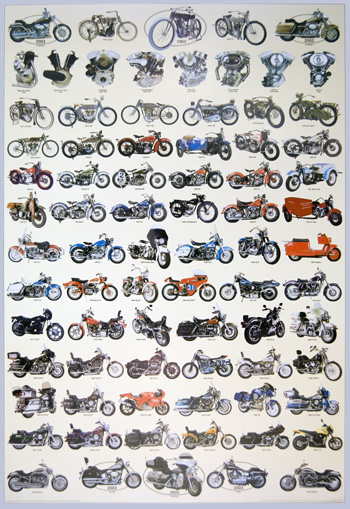
The other thing about the car example is that there is coworker of mine that has a Harley Davidson poster in his office. The poster is the evolution of the Harley Davidson. It starts with motorized bicycles and goes all the way to present day motorcycles. You can see the gradual changes in design that over a long time accumulated into something that looks nothing like the original. Changing these parts that Lisle is calling irreducibly complex, which are necessary now, but not in the past on some of the first bikes. So even his example is not of irreducible complexity.

That is all Lisle has on irreducible complexity and it is quite weak. His argument is basically one giant argument from personal incredulity, I don't see how it can happen so it must not have happened. This is a logical fallacy, which Lisle spends an entire chapter of this book on logical fallacies and how to identify them. I find it telling that he then also uses so many fallacies himself. It reminds of a passage of the bible:

"Why do you look at the speck of sawdust in your brother's eye and pay no attention to the plank in your own eye? How can you say to your brother, 'Let me take the speck out of your eye,' when all the time there is a plank in your own eye? You hypocrite, first take the plank out of your own eye, and then you will see clearly to remove the speck from your brother's eye." - Matthew 7:3-5


Dr. Ken Miller's page on irreducible complexity of the Flagellum as described by William Dembski. A very good read and deconstruction of irreducible complexity.

Wednesday, November 4, 2009

The Ultimate Proof of Creation - Chapter 1 - Section 1

This is a book by Dr. Jason Lisle of Answers In Genesis (AiG). Here is a short background on him posted on Amazon's page for this book.

"Dr Jason Lisle is a research scientist and speaker with Answers in Genesis Ministries. He holds a bachelor's degree in physics and astronomy from Ohio Wesleyan University and a master's degree and PhD in astrophysics from the University of Colorado in Boulder. Dr Lisle is currently planetarium director at the Creation Museum near Cincinnati, and written a number of books and journal articles, as well as the programs currently being used in the planetarium."

I was able to see his talk on this same subject while visiting the Creation Museum in Kentucky run by AiG. I know PZ has covered the first chapter but I wanted to take a shot at, especially after hearing Lisle's speech. Chapter 1 of his book is available online here. I will be using part of this book in accordance with the Fair Use Copyright Laws within the United States of America.

Now into the Chapter.

It starts off claiming that creationists and evolutionists use the same evidence but come to different conclusions based on their presuppositions or worldview. This is the standard canard for AiG. They forget to mention all the facts that creationists ignore when looking at the evidence. I will get to that later when he is actually talking about the evidence. This is also a straw man argument by Lisle. Creationists do insist that the Bible trumps the facts and that you should make the facts fit what the Bible says, but this is not how science works. If it was then we would all still believe in special creation, geocentric universe, a young earth, humors, leeching to get rid of "bad blood", etc. Instead science, all science, looks at the facts and follow them to the conclusions wherever they may lead. This is basic stuff, and Lisle, having a PhD from Colorado, knows this. Which leads me to believe that he is a liar for Jesus.

"One of the most compelling, commonly used scientific arguments for creation involves the field of information science. In this technological age, we are inundated with all sorts of information every day, but few people stop to consider what information really is, and where it comes from."

Well, I have a degree in Management Information Science so this should be good. Except for the first sentence, I am in total agreement.

"Scientifically, we can define information as a coded message containing an expected action and intended purpose."

Anyone can guess where he is going with this. I want to point out that he is already affirming the consequent in his definition. By calling it coded, he can say it needs a coder, much like Ray Comfort's 'creation requires a creator' bullshit.

Wikipedia has a good article on Information. Here is just a bit of it but will become important as we go here.

"Information is a term with many meanings depending on context, but is as a rule closely related to such concepts as meaning, knowledge, instruction, communication, representation, and mental stimulus. Simply stated, information is a message received and understood. In terms of data, it can be defined as a collection of facts from which conclusions may be drawn. There are many other aspects of information since it is the knowledge acquired through study or experience or instruction. But overall, information is the result of processing, manipulating and organizing data in a way that adds to the knowledge of the person receiving it.

Information is the state of a system of interest. Message is the information materialized.

Information is a quality of a message from a sender to one or more receivers. Information is always about something (size of a parameter, occurrence of an event, value, ethics, etc)."

This is what Lisle will use, information as a message. Here is Lisle on DNA.

"DNA also contains information. DNA (deoxyribonucleic acid) is a long molecule found within living cells and resembles a twisted ladder. The rungs of the ladder form a pattern of base pair triplets that represent amino acid sequences — the building blocks of proteins. DNA contains the “instructions” to build the organism. So different organisms have different DNA patterns. DNA qualifies under the definition of information: it contains an encoded message (the base pair triplets represent amino acids) and has an expected action (the formation of proteins)and an intended purpose (life)."

At first glance this seems right, but he has changed the definition of information. In this sense information is "a type of pattern that that influences the formation or transformation of another pattern" (from Wikipedia). For this definition there is no need for a sender or receiver, in essence it is a chemical reaction or like the cogs of clock. When one moves the other has to because of the interlocking relationship. This is similar to how chemical reactions work, in which DNA is a chemical (two polymers with sugar and phosphate bonds to be specific). There is a lot of work going on in understanding DNA and I don't want to get bogged down in technicalities here, so I differ to Wikipedia (DNA) again.

"Whenever we find any sort of information, certain rules or “theorems”
apply. Here are two such theorems:

1. There is no known law of nature, no known process, and no
known sequence of events that can cause information to originate
by itself in matter.

2. When its progress along the chain of transmission events is
traced backward, every piece of information leads to a mental
source, the mind of the sender."

Lisle's wonderful source for these theorems (which I never heard either of these in college) is Werner Gitt (I wish I was making that name up). They are both from Gitt's book In the Beginning Was Information. It is a creationist book. Gitt is a yec and amazingly works for AiG, just like Lisle.

Both of these theorems are garbage. Scientists have observed the duplication or doubling of strands of DNA, followed by mutation affecting a single one of those strands changing it into something entirely different than what was there originally. This would be the adding of "information." As for actually originating "information" this would be covered under abiogenesis. In which some remarkable studies are going on. Recently a new article was published on a very likely way in which RNA (a precursor for DNA) could have formed on a very young Earth. This would be a complete natural origin for "information".

Theorem number two is just weird. Every source of information? Well I guess it again depends on what you mean by information. Where is the source of the "information" that tells an oxygen atom and two hydrogen atoms to bond together to form water? This is yet another straw man.

"In one sense, these theorems are hardly profound; we take for granted that when we read a book it has an author. No one reading this book would conclude that it was generated by a sequence of typos that gradually accumulated over time. Now certainly this book might be a copy of a copy of a copy, but you take it for granted that a mind is ultimately responsible for the information therein (regardless of whether you agree with the information!). The theorems of information science confirm this."

Argument from personal incredulity or argument from common sense, yet another logical fallacy. First it is a false analogy. Books do not reproduce on their own. Humans guide the process of recreating books, often at great extent. Yet they still get transmission errors. I guess in Lisle's world God is actually guiding every chemical reaction that is involved in reproduction, no wonder he has no time to answer prayers.

Lisle has also set up Gitt's theorems like they are the widely accepted in the field of Information Science, this is far from the truth. From Wikipedia on Gitt and Tom Schneider's works:

"Tom Schneider of the Molecular Information Theory Group at the National Institutes of Health, an expert on the application of evolution to biology similarly criticizes his use of unproved 'theorems', use of circular reasoning, self-contradiction, 'Gitt has gotten Shannon backwards' and that Gitt falls into a 'standard misunderstanding that information is not entropy, information is not uncertainty'"

To trot out Gitt's work like it is highly respected and contains actual theorems (theorem - a statement that can be demonstrated to be true by accepted mathematical operations and arguments) is deluded at best and dishonest at worst. Thus going back to my original opinion that Lisle is intentionally lying for Jesus.

"Likewise, these theorems tell us that life cannot have come about as the evolutionists claim. The information in DNA cannot have come about by mutations and natural selection because the laws of information science tell us that all information comes from a mind. But the information in DNA makes sense in light of biblical creation. It was by the mind of God that the initial information was placed in the DNA of the original organisms on earth. That information has been copied many times, and some of it has been lost. But the information in our DNA ultimately comes from God, not by a random chance process. The laws of information science confirm creation."

This is only true if these "theorems" are true, which Gitt nor Lisle have done anything to prove them. Thus this argument relies on a faulty premise and fails before it even starts.

Also by the definition of information as a message (information is a message received and understood), the second part of that definition requires the receiver to be able to understand the message. In other words the receiver has to have a mind also. Otherwise it would be akin to a person writing detailed messages and then throwing them into a furnace to be destroyed without anyone ever reading them. So by Lisle's definitions each cell of our or any living body must have a mind.

"Sometimes evolutionists will object to this and will point out that mutations occasionally have survival value; they “improve” the organism under certain circumstances. This is true, but it is not relevant to the argument. Mutations have
never been observed to add brand-new information, and thus they cannot be the driving mechanism of evolution. Sometimes mutations will cause a section of DNA to get duplicated, but does this really increase the information? Not at all. By analogy, a copying error in a book may cause a paragraph to get duplicated. But surely it adds no new information. After all, could you learn anything from the duplicated paragraph that you couldn’t learn from the original? Creative information cannot spontaneously increase by chance. It is always the result of intelligence. The theorems of information science tell us this, and our experiences confirm it."

Now Lisle, you are just being obtuse. Ever thought about combining these two processes?

1. We take a sentence:
The dog hates cats.

2. We duplicate it:
The dog hates cats. The dog hates cats.

3. We add a beneficial mutation to the addition:
The dog hates cats. The dog hates cars.

UH-OH! We now have new information about the dog, through the two processes you just said couldn't create new information. You might want to rethink things.

That is it for Information Science section of Chapter 1, next section the thoroughly debunked idea of Irreducible Complexity.

I also want to add, I love the pictures. Notice he pulls a Jack Chick, not as prominent as Chick does though, in that he makes the evolutionist look uglier than the Christian.

Tuesday, October 13, 2009

Secular Student Association


The SSA is a great organization helping to unite students in universities all over the country. Right now they are trying to raise $50,000 that will be matched by a donor. If you have a few dollars to donate it will be much appreciated.

This is the organization that got the Creation Museum tour, that I went on, together.

Monday, August 24, 2009

Sneaky sneaky

In a good way.

Aaron Gardner is a preacher, but for one day he donned a scarlet A and joined PZ Myers and 300 others in a museum tour. It was very eye opening for him.

http://pastoraaron.info/2009/08/11/scarlet-a-for-a-day

http://pastoraaron.info/2009/08/13/and-this-atheist-was-a-walking-christian-tract/

http://pastoraaron.info/2009/08/14/atheism-at-the-creation-museum/

Thursday, August 13, 2009

Creo Zerg!

I am finally getting to my impression of the Creo Zerg (tm).

I left work on Thursday at 11am. The drive to Kentucky took 12 hours and 15 minutes plus there was a time change where I got to skip over most of the 9 o'clock hour (9 to 10 pm is the worst hour of the night anyway...). So I finally make it to the hotel around 12:30 am. I meet Froggie/E-lad/Dale at the hotel, we shared a room to cut the cost down. Dale started posting about our adventures that night at SMRT. I was very tired but stayed up a bit and talked.

The next morning, we had breakfast and made our way to the museum. At breakfast I noticed a family of Pentecostal Holiness followers. They are usually easy to spot as the women are not allowed to cut their hair and have to wear dresses at all times. When we got to the museum, I saw the same family there with a group of other similarly dressed people. The shock and horror on their face was rather funny.

Anyway, the place has been covered pretty well and I don't have much else to add, except my pictures. So here is the link to my photo album.

Creation Hamseum

I started this post a few days ago and am now just finishing it. I realized I am not going to cover much different except my pictures.